
The concept of the visual schedule is actually quite simple. Provide visuals in the form of actual objects, pictures, or written words to help someone learn and understand what is to come and to know what to expect. It can be as simple or complex as needed. The visual allows the person to process the information without the distraction of added words and verbal instruction. Visual schedules can be used for individual tasks, to break down steps of an activity, or they can be given to help people understand the expectations for the day. They can be used essentially anywhere whether at home, school, or even on the go.
How many of us as adults need a visual schedule? I certainly do! Have you ever put together a piece of furniture without instructions? Some of those are difficult WITH instructions! I also need my monthly calendar to remind me when I have bills to pay and when I have certain events coming up. I rely on my daily visual schedule at work to remind me of my appointments, and to know if there have been cancellations or new appointments added. If I went into the day without knowing my schedule or what to expect, especially if it was something that I had never done before, it would most likely bring me anxiety, and could possibly throw me off for a bit.
Kids that may benefit
Now think about your kiddo and how many things they may face during the day that may bring uncertainty. There are many! This can be difficult especially for our kiddos that are not good with change and have difficulty with flexibility. If I can get flustered when my schedule is off, I can only imagine how some of our kiddos may feel when their schedules are off, not knowing what to expect or what may be expected of them. Their anxiety and uncertainty may come out as frustrated behaviors, increased arousal, refusals, defiance, outbursts, thus having difficulty transitioning. The visual schedule may help them with understanding and expectations.
Think about your kiddo who has a short attention span and often forgets about what they are told. They may be fairly flexible in their thinking and do a better job accepting change, but are easily distracted and have a hard time focusing. A visual schedule may be a good tool to help them remember what they should be doing, thus helping them redirect to tasks.
Visual schedules are a great tool but are not the end all be all to fix a problem. Visual schedules still need to be taught and there needs to be consistency in order for kids to learn how to use them. It may be a step by step process to start, with the hopes that they become independent with the support.
Making the visual schedule
Okay, the first thing you need for a visual schedule are visuals! You can purchase pre-made visual schedule sets with different options while often minimizing the “work” in the set-up. Though there are many good options out there, let me teach you how you can make your own visual schedule which also allows for it to be more customized. Here are some possibilities.
You can do a “Google search” to look up images to copy and paste onto a word document. These can be general items such as a sink picture, or an icon for washing hands, or a picture of a “bed” for bedtime. You can also find specific pictures of items around your house, or pictures of your kiddo’s favorite toys or stuffed animals to use. Size them to your liking, print them, and cut each picture out. You now have visuals!


If you plan on making a bunch of these, you may benefit from investing in a laminator to help with durability and longevity of the visuals. You can then purchase some Velcro strips or dots to place on the back of the visuals so you can stick them wherever you want your schedule to be, whether on a wall, cabinet, the fridge, or a separate laminated sheet for on-the-go accessibility.
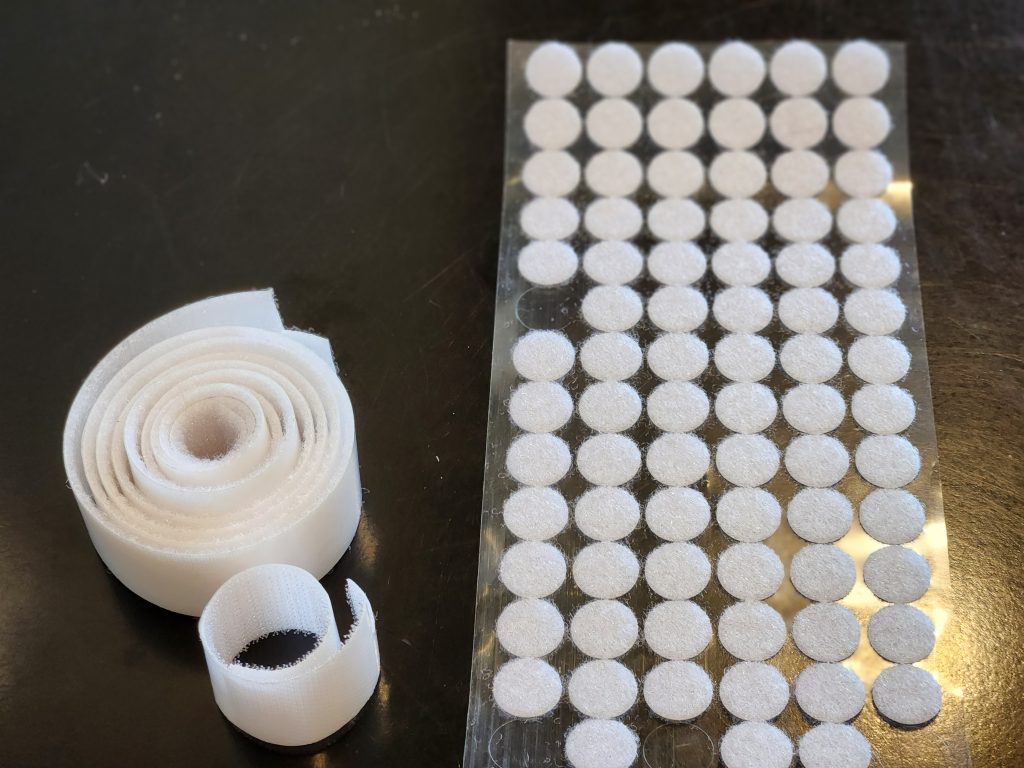

Don’t want to get a laminator? Try clear packing tape to protect the visuals! Sandwich them together for individual use or tape them to a background for those schedules that remain consistent, such as brushing your teeth or steps to get dressed (underwear, socks, pants, shirt).
Teachers! You do a great job with schedules, writing the daily schedule on the board. But for those kiddos that may be in and out of your class due to extra services, use clear packing tape to tape a mini schedule on top of their desk in the corner as a reference to help them remember.
Do you have a Polaroid camera? Take pictures of items you have around the house, or take pictures of your kiddo performing a task to put into a visual schedule. You can also use your phone to take pictures and have them printed at the drug store. They also have instant photo printers for your smart phone to print out for ready to use photos.
Dry erase board are also very versatile. If you have a larger one, you can set up a daily schedule to help your kiddo know what to expect. You can use a smaller “personal” sized dry erase board to draw or write out a schedule to break down an activity. I will often draw or write out a 3-5 step schedule for kiddos to refer to and let them cross off or erase each step once finished.


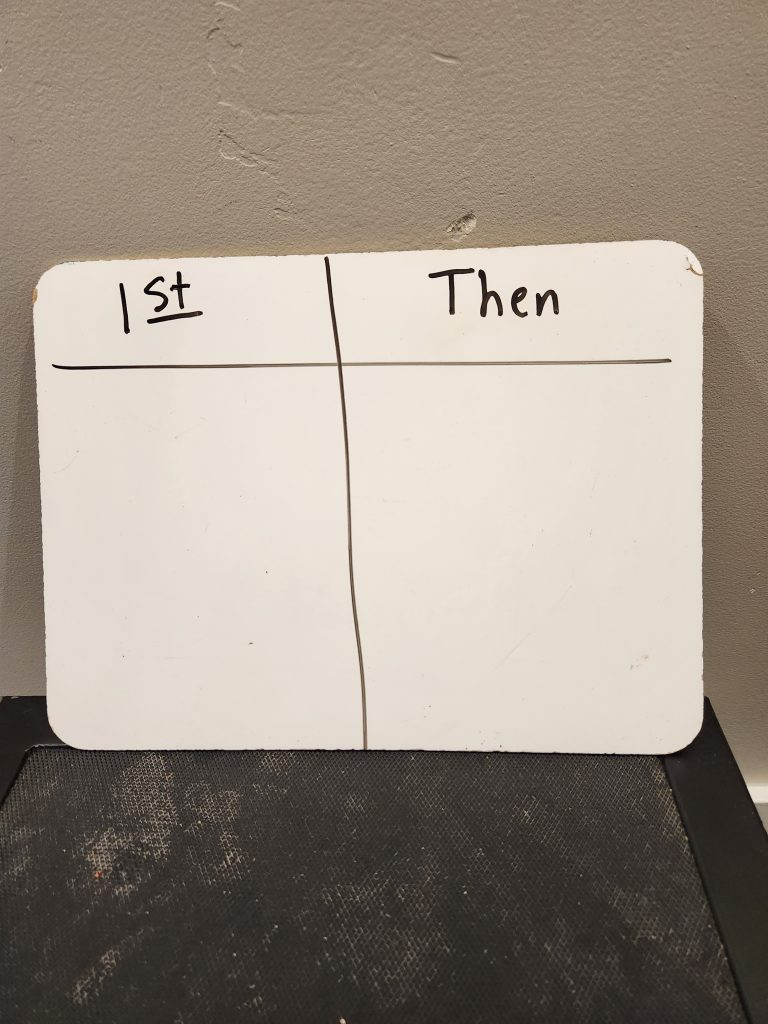
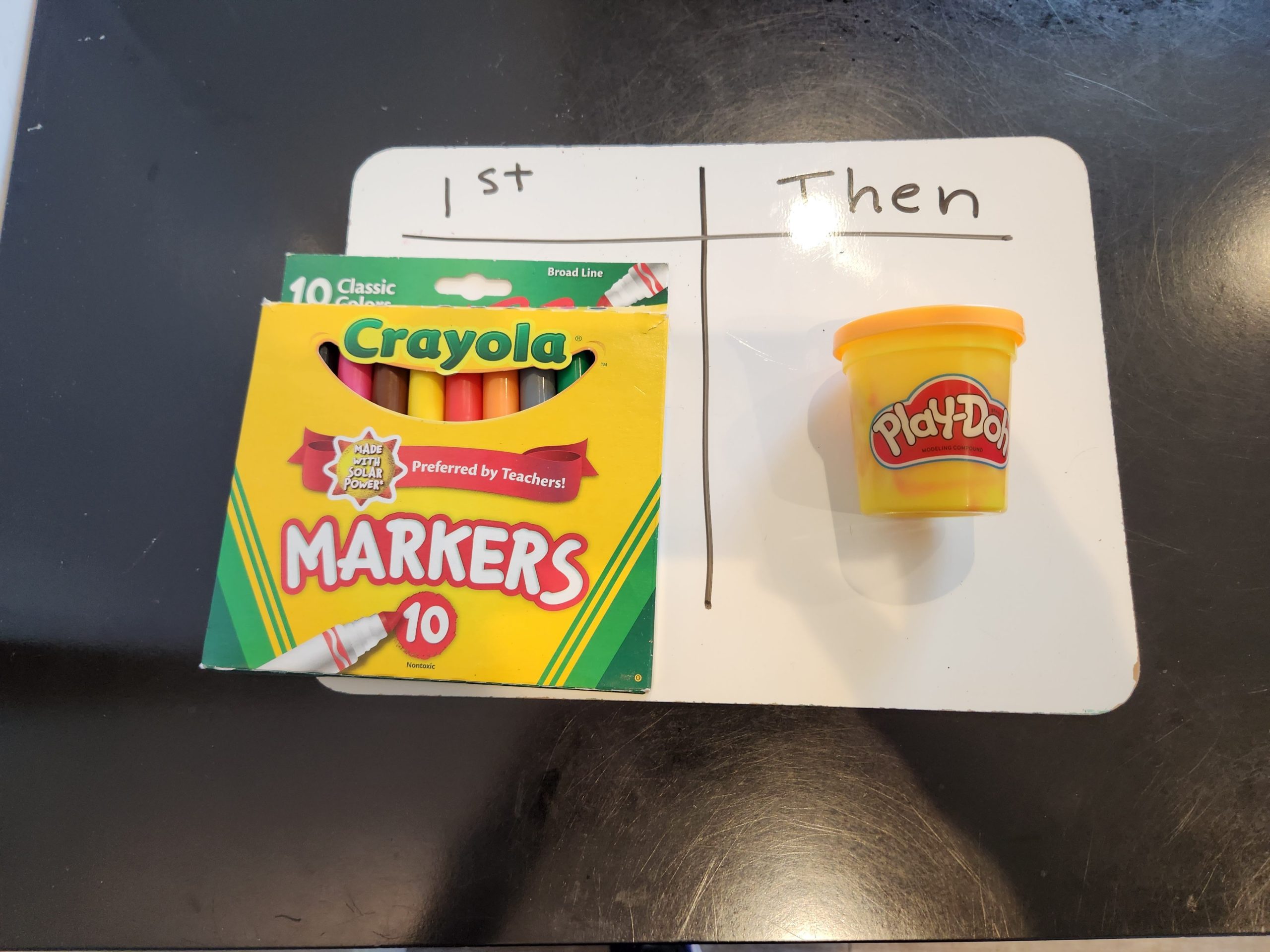
You can make a 1st/Then chart using visuals, drawing pictures, or using objects. It is basically teaching the kiddos, “1st” we will do this, “Then” we will do this. You can use a blank paper or a dry erase board with a line down the middle. Write “1st” on the top of one side and “Then” on the top of the other. You can also laminate a “1st/Then” sheet and place Velcro strips or dots on either side to place your visuals upon. An example would be, 1st we will wash hands, Then we will do the obstacle course. Or, 1st we will trace the letters, Then we will play with Play-Doh. Use the “Then” side as a preferred or motivating activity to work on inflexibility or when working on non-preferred tasks.
The take home for the visual schedule is that they help kiddos remember and understand what to expect. There are many purposes for visuals that are beneficial, but for this occasion, I wanted to share how visual schedules can be made. When it comes down to it, you know where your kiddo is at. Remember, start simple, stay consistent, and be creative! I hope that these ideas and suggestions have been helpful and that they have spurred some ideas of your own!
No responses yet